Pageoptimized
Module 11

AI visibility research and tracking

Design buyer-centered prompts, establish a repeatable testing protocol, and track mentions, accuracy, citations, competitors, and source gaps over time.

  • SEO specialists
  • Brand teams
  • Researchers
  • Agencies
Module case file

Northstar CRM wants to know why competitors appear in buyer answers

A 20-prompt buyer-question set is tested across named engines and dates. The objective is to connect each observed answer to its sources, page gaps, accuracy, and next action.

Prompt set
20 approved mid-market CRM buyer questions
Competitors
HubSpot, Zoho, Pipedrive
Tracked evidence
Response, mention, citation, cited page, accuracy
Cadence
Weekly, fixed prompt wording and engine mode
Your finished deliverable

Finish a prompt protocol, diagnose one source gap, and create a history record that distinguishes movement from normal answer variation.

Lesson 11.1

Research real buyer questions

Build prompts from audience decisions, not a list of brand-friendly formulations.

Why this matters

Useful prompts cover discovery, comparison, constraints, risk, implementation, alternatives, and post-purchase questions. They should reflect language people actually use.

Build yours

  1. Collect customer, sales, support, community, and search language.
  2. Group questions by decision task.
  3. Include category, comparison, constraint, and branded questions.
  4. Remove prompts that only exist to flatter the brand.
Completed example: Northstar CRM

Buyer-question set

Questions come from real evaluation tasks and retain audience context.

Finished output

Audience
Operations leads at 50-250 person companies
Discover
Which CRMs handle multi-pipeline sales teams?
Compare
Northstar CRM vs. HubSpot for implementation effort
Validate
Does Northstar support SSO and EU data residency?
Act
What should a CRM migration plan include?
Decision

Approve 20 questions that represent buyer tasks, not repetitive brand prompts.

Save this in

Prompt Lab set: Mid-market CRM evaluation v1.

Before you move on

  • Prompts map to real decisions.
  • The set includes non-branded questions.
  • Leading or manipulative wording is removed.
Lesson 11.2

Define the testing protocol

Make repeated observations comparable.

Why this matters

A protocol controls what can be controlled and records what cannot. Without it, a changed answer can be mistaken for progress.

Build yours

  1. Record engine, product mode, account state, location, and date.
  2. Use approved prompt text and segments.
  3. Choose repetition and cadence.
  4. Define mention, recommendation, citation, accuracy, and competitor rules.
  5. Preserve raw responses and sources.
Completed example: Northstar CRM

Reproducible AI visibility protocol

The protocol keeps changing answer conditions visible.

Finished output

Cadence
Weekly on Monday at 09:00 UTC
Prompt
Exact approved text; no silent edits
Environment
Engine, model/mode, location, session state recorded
Capture
Full response, mentions, citations, cited URLs, accuracy
Versioning
Prompt-set changes create a new version
Decision

Compare only runs with matching protocol fields; label platform variation explicitly.

Save this in

AI Tracker schedule and Prompt Lab version history.

Before you move on

  • The protocol can be repeated.
  • Metrics have definitions.
  • Raw evidence is retained.
Lesson 11.3

Diagnose source and answer gaps

Turn missing or inaccurate visibility into testable hypotheses.

Why this matters

A brand may be absent because the prompt is irrelevant, the site lacks useful coverage, sources contradict it, engines retrieve different documents, or the observation is unstable. Diagnose before creating content or outreach.

Build yours

  1. Inspect the full response and cited sources.
  2. Compare competitor mentions and source domains.
  3. Check owned-page coverage and factual consistency.
  4. List plausible explanations.
  5. Choose the smallest verification or improvement step.
Completed example: Northstar CRM

Source-gap diagnosis

A missing mention is traced to the sources and page evidence in the answer set.

Finished output

Prompt
Best CRM for multi-pipeline teams
Observed
HubSpot and Zoho named; Northstar missing
Cited sources
Two independent comparison pages and one vendor guide
Northstar gap
No source-backed multi-pipeline comparison page
Confidence
Medium; source gap observed, selection cause unknown
Decision

Create a sourced comparison brief only if it serves buyers beyond the tracking metric.

Save this in

AI Tracker diagnosis -> Content Plan brief with cited-source evidence.

Actual product · four evidence views

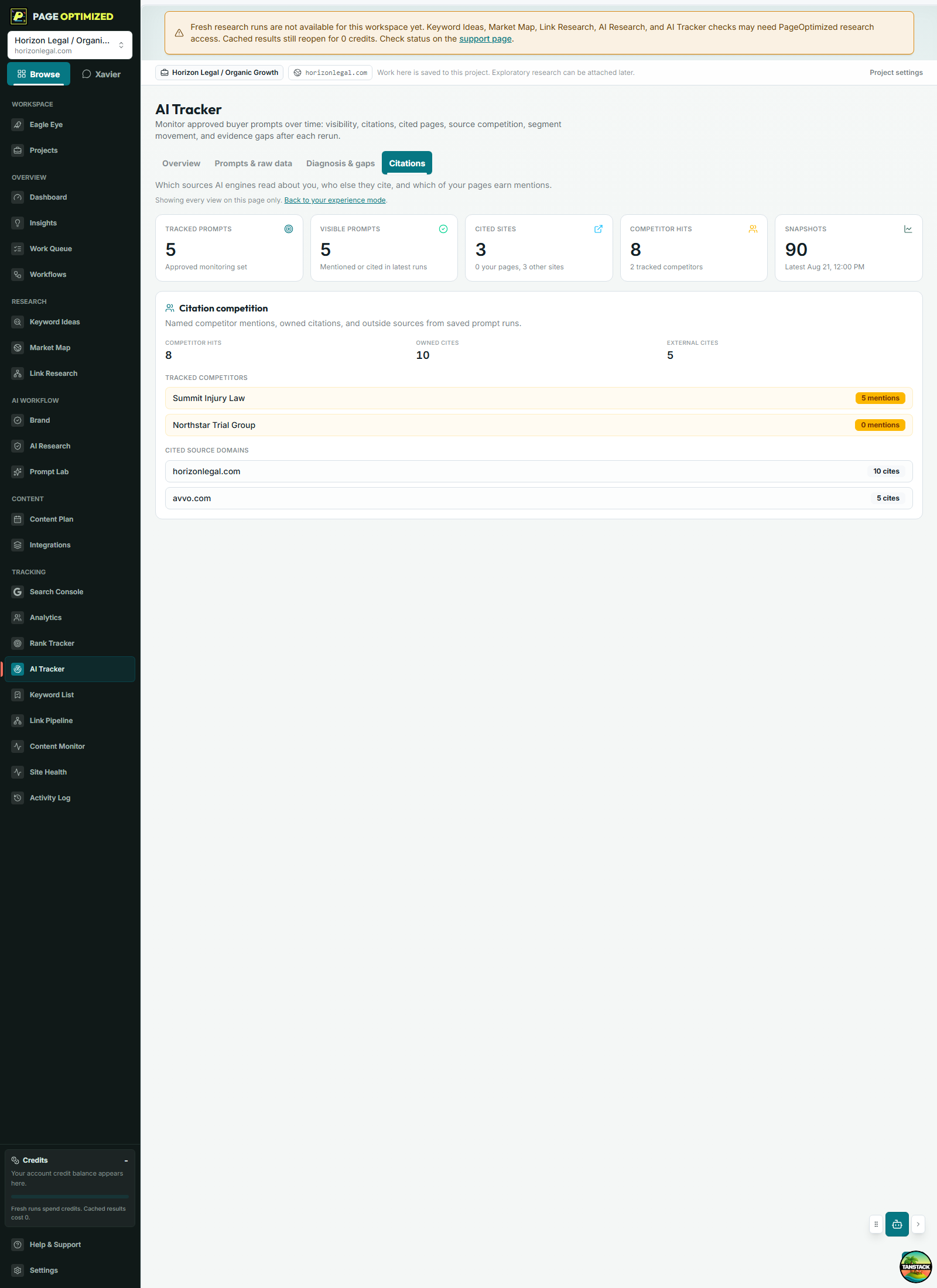
Inspect the sources behind visibility

The Citations view shows which domains and pages support answers, where competitors appear, and which source gaps deserve investigation.

PageOptimized AI Tracker citations view showing cited domains, pages, source coverage, and competitor evidence.Open full size
  1. Choose a prompt cohort.
  2. Open cited sources.
  3. Verify what each source supports.
  4. Create a hypothesis with a retest date.

Before you move on

  • Absence is not automatically called a trust gap.
  • Competitor evidence is inspected.
  • The action is proportional to confidence.
Lesson 11.4

Track change and accuracy

Measure repeated observations beside the work and organic search evidence.

Why this matters

Track prompt cohorts and source movement over time, but keep AI visibility distinct from organic rankings and business outcomes.

Build yours

  1. Approve the tracked set.
  2. Run on a defined cadence.
  3. Review mention, accuracy, citation, sentiment, and competitor movement separately.
  4. Attach work shipped during the period.
  5. Report uncertainty and next verification.
Completed example: Northstar CRM

AI visibility change record

Movement and factual accuracy are reviewed separately.

Finished output

Prompt set
Mid-market CRM evaluation v1; 20 prompts
Visibility
Named in 8 of 20, up from 6
Citations
5 cited pages, up from 3
Accuracy
One response still misstates SSO availability
Protocol
Same engine, mode, prompts, and weekly cadence
Decision

Treat the gain as observed movement; create a correction task for the inaccurate SSO claim sources.

Save this in

AI Tracker weekly history plus Brand accuracy task.

Actual product

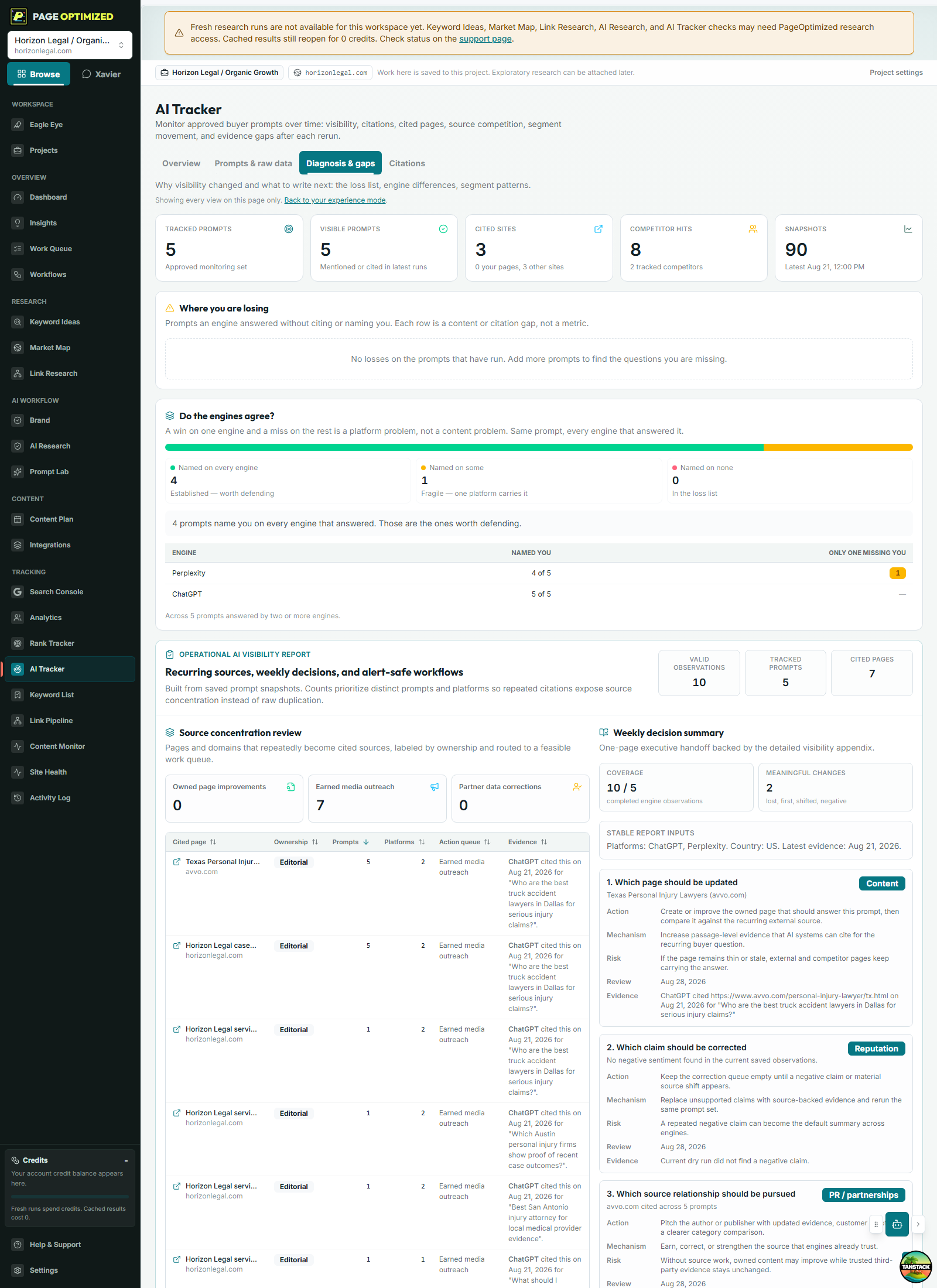
Move from metric to diagnosis

Diagnosis panels keep engine gaps, losses, source patterns, and recommended verification beside the tracked evidence.

PageOptimized AI Tracker diagnosis view showing engine gaps, prompt losses, source patterns, and follow-up evidence.Open full size
  1. Find the changed cohort.
  2. Review the raw evidence.
  3. List plausible causes.
  4. Assign a verification task.

Before you move on

  • Cohorts are stable enough to compare.
  • Accuracy has a human review path.
  • Visibility is not reported as revenue without evidence.
Primary references

Verify the practice at the source.

Practices and source links reviewed August 2026.