Pageoptimized
Module 02

Market and keyword research

Find the language, pages, competitors, and demand patterns that matter, then turn research into a qualified project list rather than an export nobody uses.

  • Business owners
  • SEO beginners
  • Content teams
  • Agencies
Module case file

Horizon Legal must choose its next Austin topic

The firm already has service and location pages. The research task is to find useful Austin personal-injury demand without creating thin city variants or exporting thousands of unqualified keywords.

Audience
People in Austin evaluating injury-law options
Market
United States, English
Existing coverage
/personal-injury/austin/ and /truck-accidents/
Research seed
personal injury lawyer austin
Your finished deliverable

Produce a qualified keyword set in which every saved row has a target page, evidence, and one action: improve, create, consolidate, monitor, or reject.

Lesson 2.1

Write the research brief

Define the market and decision context before generating keyword rows.

Why this matters

A seed keyword without context produces a larger list, not necessarily a better decision. The research brief keeps the work tied to real people, locations, offers, information needs, and site constraints.

Build yours

  1. Name the audience and the problem, task, product, service, or topic they are trying to understand.
  2. Record the geographic market and language.
  3. List the pages or offers the site already has.
  4. List known competitors, including publishers or marketplaces that compete in search without selling the same thing.
  5. Define what would disqualify a keyword, such as the wrong country, audience, intent, product, or risk level.
Completed example: Horizon Legal

Austin injury-law research brief

The brief narrows the research before a tool generates rows.

Finished output

Audience task
Compare an Austin injury lawyer after an accident
Market
United States, English, Austin service area
Existing pages
/personal-injury/austin/; /truck-accidents/
Search competitors
Local firms, directories, legal publishers
Reject
Other states, jobs, legal education, unsupported case types
Decision

Research one service-location cluster first; reject demand that the firm cannot serve.

Save this in

Project note: Austin personal injury research brief - Aug 2026.

Before you move on

  • The brief is specific enough to reject irrelevant demand.
  • Search competitors are not assumed to equal business competitors.
  • Existing pages and constraints are visible.
Lesson 2.2

Map the existing organic market

Use domains and pages to see where demand is already being captured.

Why this matters

Market estimates are directional. They help compare domains, page groups, keyword portfolios, and movement; they are not the site's analytics and should not be reported as exact traffic.

Build yours

  1. Open Market Map and enter the site domain without a protocol or path.
  2. Choose the correct country and decide whether subdomains belong in scope.
  3. Review organic keywords, estimated traffic, traffic value, ranking distribution, and movement together.
  4. Open top pages to identify page types and topics producing visibility.
  5. Compare at least two relevant domains and record where their page portfolios differ.
Completed example: Horizon Legal

Market Map observation

The finished output records the comparison that changes the next research step, not every modeled row.

Finished output

Scope
US database; root domains; subdomains excluded
Observed pattern
Competitors win with service-location pages and settlement utilities
Portfolio gap
Horizon has fewer Austin-specific accident pages
Confidence
Directional; traffic and value are estimates
Decision

Expand Austin service intent and settlement-calculator tasks before broader injury terms.

Save this in

Market Map saved observation: Austin portfolio gap.

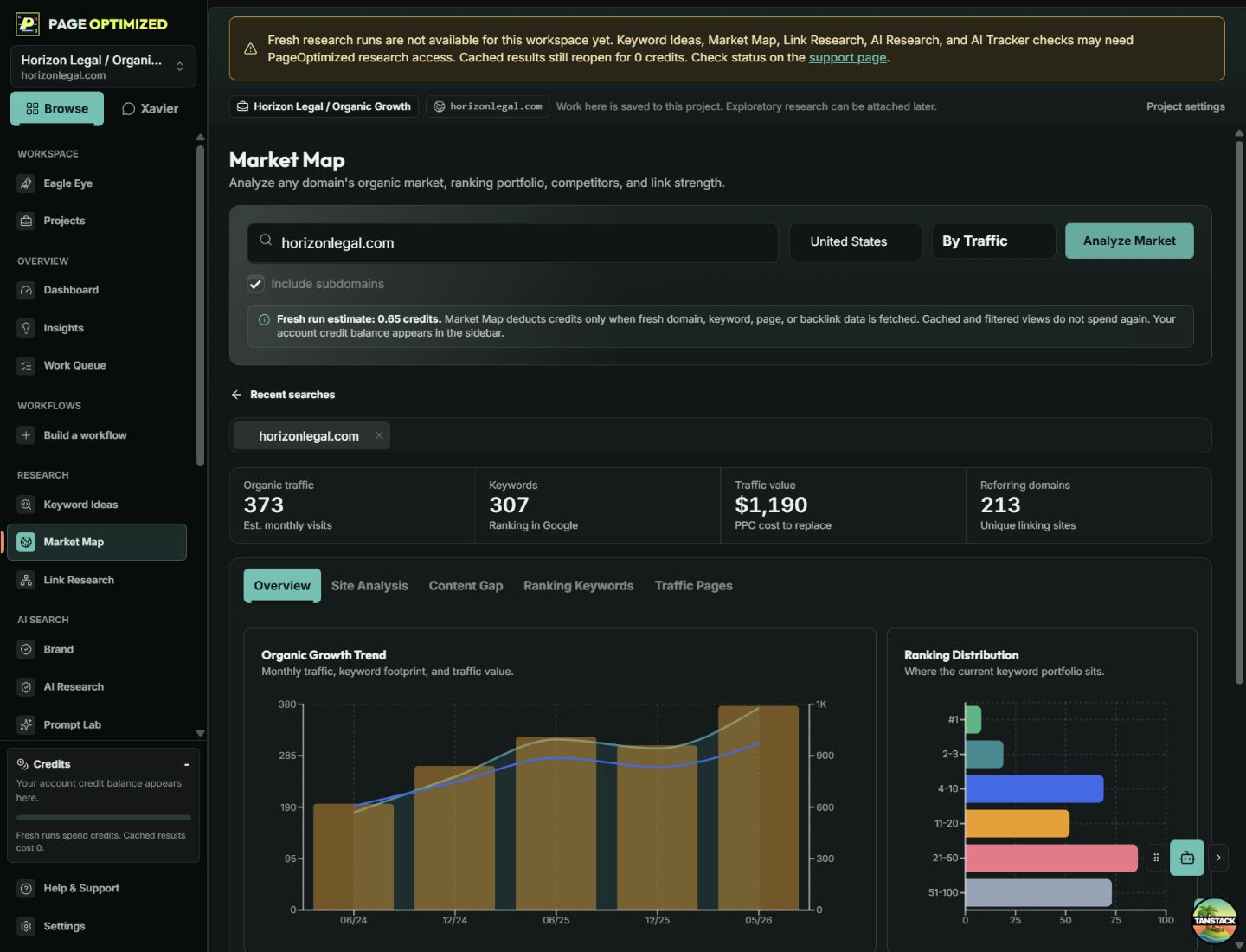
Product source · Market Map

Read the market before expanding keywords

Read the selected market and domain scope before comparing estimated traffic, ranking distribution, movement, pages, and keywords. The finished observation above records the portfolio gap this view supports.

PageOptimized Market Map showing an example domain's organic traffic, ranking keywords, traffic value, position distribution, and trend history.Open full size
  1. Confirm country and subdomain scope.
  2. Compare traffic, keyword count, value, and distribution.
  3. Open pages and keywords before naming an opportunity.
  4. Label every modeled number as an estimate.

Before you move on

  • The country and subdomain scope are recorded.
  • Estimates are labeled as estimates.
  • The output names page and topic patterns, not just a winning domain.
Lesson 2.3

Expand focused seed topics

Generate a useful set of related queries without treating volume as a strategy.

Why this matters

Searchers with different experience levels describe the same need differently. Related terms reveal language, modifiers, comparisons, questions, and page-type expectations that a team may not use internally.

Build yours

  1. Start with one focused seed drawn from the research brief.
  2. Set the same market and language used in Market Map.
  3. Review volume, difficulty, CPC, competition, intent, and trend as separate signals.
  4. Inspect outliers and set-aside ideas before filtering; unexpected language can reveal a different task or audience.
  5. Repeat only for clearly distinct topic families rather than near-duplicate seeds.
Completed example: Horizon Legal

Focused seed research packet

One seed becomes a reviewable packet with intent and page-fit notes.

Finished output

Seed
personal injury lawyer austin
Keep
austin personal injury attorney; truck accident lawyer austin
Review
settlement calculator texas; injury lawyer near me
Reject
personal injury lawyer salary; law school terms
Rule
Volume, difficulty, CPC, intent, and trend remain separate signals
Decision

Inspect the result page and existing URL before choosing create versus improve.

Save this in

Keyword Ideas run attached to the Austin research brief.

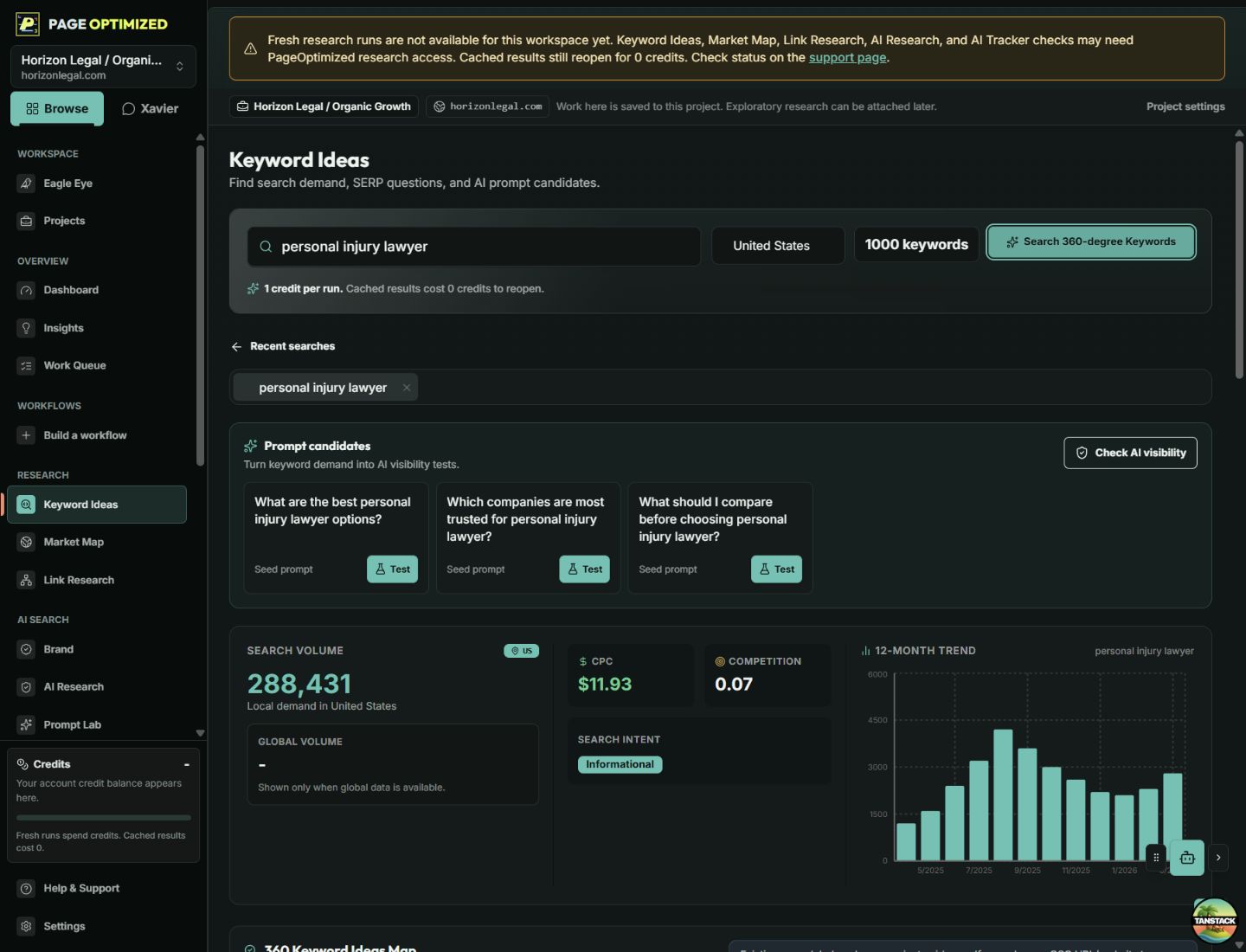
Product source · Keyword Ideas

Turn one focused seed into a research packet

Keyword Ideas keeps demand, difficulty, cost, intent, trends, wider-net ideas, and the save path together so the next step does not start from a bare CSV.

PageOptimized Keyword Ideas showing a focused seed with search volume, difficulty, CPC, intent, trends, and related keywords.Open full size
  1. Enter one seed and the correct market.
  2. Review metrics as separate signals.
  3. Inspect the result page and current site coverage.
  4. Save only rows with a defined next action.

Before you move on

  • Every seed maps to the research brief.
  • No keyword is selected on volume alone.
  • Unexpected terms are reviewed before exclusion.
Lesson 2.4

Qualify intent and page fit

Decide whether a query deserves a new page, an existing-page improvement, monitoring, or no action.

Why this matters

Intent labels are a first pass. The result page, current rankings, business fit, and existing content determine what action is appropriate.

Build yours

  1. Describe the task the searcher is trying to complete.
  2. Inspect the dominant page types and result features.
  3. Check whether an existing page already satisfies that task.
  4. Choose one action: improve, create, consolidate, monitor, or reject.
  5. Record the evidence and confidence instead of assigning a page type from a keyword modifier alone.
Completed example: Horizon Legal

Intent and page-fit decision

The keyword is evaluated against the searcher's task and current site coverage.

Finished output

Query
truck accident lawyer austin
Searcher task
Evaluate local counsel for a truck-accident claim
Observed page type
Local service pages dominate
Current fit
General truck page exists; Austin intent is incomplete
Confidence
High after result-page review
Decision

Improve the existing truck page with an Austin section before considering a separate URL.

Save this in

Keyword List row with action Improve and target /truck-accidents/.

Before you move on

  • The chosen action considers existing coverage.
  • The intended page type matches the observed result set.
  • Rejected keywords include a reason.
Lesson 2.5

Save a decision-ready keyword set

Preserve the research packet so execution does not begin from a stripped-down spreadsheet.

Why this matters

A useful keyword record retains its market, metrics, intent, SERP context, target page, tags, and intended action. Saving only the keyword text forces the next person to repeat the research.

Build yours

  1. Select only qualified rows and save them to the project Keyword List.
  2. Tag by topic, audience, location, funnel task, client, or another decision-relevant dimension.
  3. Attach an existing target URL when one should be improved.
  4. Send approved new-page opportunities to Content Plan.
  5. Add monitoring keywords to Rank Tracker only when movement will change a decision.
Completed example: Horizon Legal

Decision-ready keyword set

Every retained row carries enough context for execution or monitoring.

Finished output

Improve
truck accident lawyer austin -> /truck-accidents/
Monitor
personal injury lawyer austin -> /personal-injury/austin/
Create brief
texas settlement calculator examples -> calculator support guide
Tags
Austin; service; commercial; priority Q3
Decision

Save three qualified rows; leave rejected rows in the research record with reasons.

Save this in

Keyword List, then Content Plan or Rank Tracker according to the selected action.

Before you move on

  • Every saved keyword has an action or review state.
  • Tags support a real reporting or execution decision.
  • The handoff retains evidence and ownership.
Primary references

Verify the practice at the source.

Practices and source links reviewed August 2026.