Pageoptimized
Module 01

Search and AI discovery fundamentals

Understand what crawling, indexing, ranking, answer generation, and conversion each mean before changing a page or reporting a result.

  • Business owners
  • SEO beginners
  • Senior specialists
  • Agencies
Module case file

Horizon Legal needs a baseline it can act on

Horizon Legal is a multi-location Texas personal injury firm. You are taking over organic search on August 21, 2026. The team wants more qualified consultation requests, but Analytics is not connected and the technical audit could read only seven of eight sampled pages.

Primary audience
Texas residents comparing injury counsel
Market
United States, all devices, organic search
Baseline period
Jul 22-Aug 18, 2026 vs. the previous 28 days
Known coverage
4 of 5 sources connected; Analytics is missing
Product evidence
Dashboard, Search Console, Site Health, Rank Tracker
Your finished deliverable

Leave the module with one dated baseline record, one measurement tree, and three owned follow-up items. Every number must name its source; every unknown must remain unknown until a source is connected.

Lesson 1.1

Start with the outcome, not a ranking

Define what useful organic discovery means for this specific website.

Why this matters

SEO is not a universal race for more visits. A local firm may need qualified calls, a publisher may need engaged readers, an ecommerce store may need profitable product discovery, and an agency may need evidence that completed work changed visibility or demand.

Choose one primary outcome and one guardrail. The outcome tells you what success means. The guardrail prevents a misleading win, such as traffic rising while qualified inquiries fall.

Build yours

  1. Name the site type, primary audience, and the decision visitors should be able to make.
  2. Choose one primary outcome: lead, sale, subscription, visit, donation, application, or another observable action.
  3. Choose one guardrail: lead quality, revenue per visit, engaged time, return rate, margin, or client-approved conversions.
  4. Write the current measurement limitation instead of filling a missing number with an estimate.
Completed example: Horizon Legal

Organic discovery outcome brief

This is the finished brief the learner should have before discussing rankings or traffic.

Outcome definition

Audience
Texas residents comparing personal injury counsel
Decision
Decide whether to request a consultation
Primary outcome
Qualified consultation requests from organic visits
Guardrail
Consultation-to-signed-case rate

Current measurement boundary

What we can measure
Crawl health, Search Console visibility, tracked rankings
What we cannot measure yet
Organic consultations and signed cases
Reason
Analytics is the missing fifth connection
Decision

Do not call higher clicks a business win until organic consultation events and the CRM outcome are connected.

Save this in

Work Queue: Measurement setup - organic consultations. Owner: Analytics lead. Due: Aug 28, 2026.

Product source · Dashboard

Read the project before prescribing work

Start at the Dashboard coverage row. It shows 4 of 5 evidence sources connected, which is why the outcome brief records consultations and signed cases as unknown instead of treating clicks as the final result.
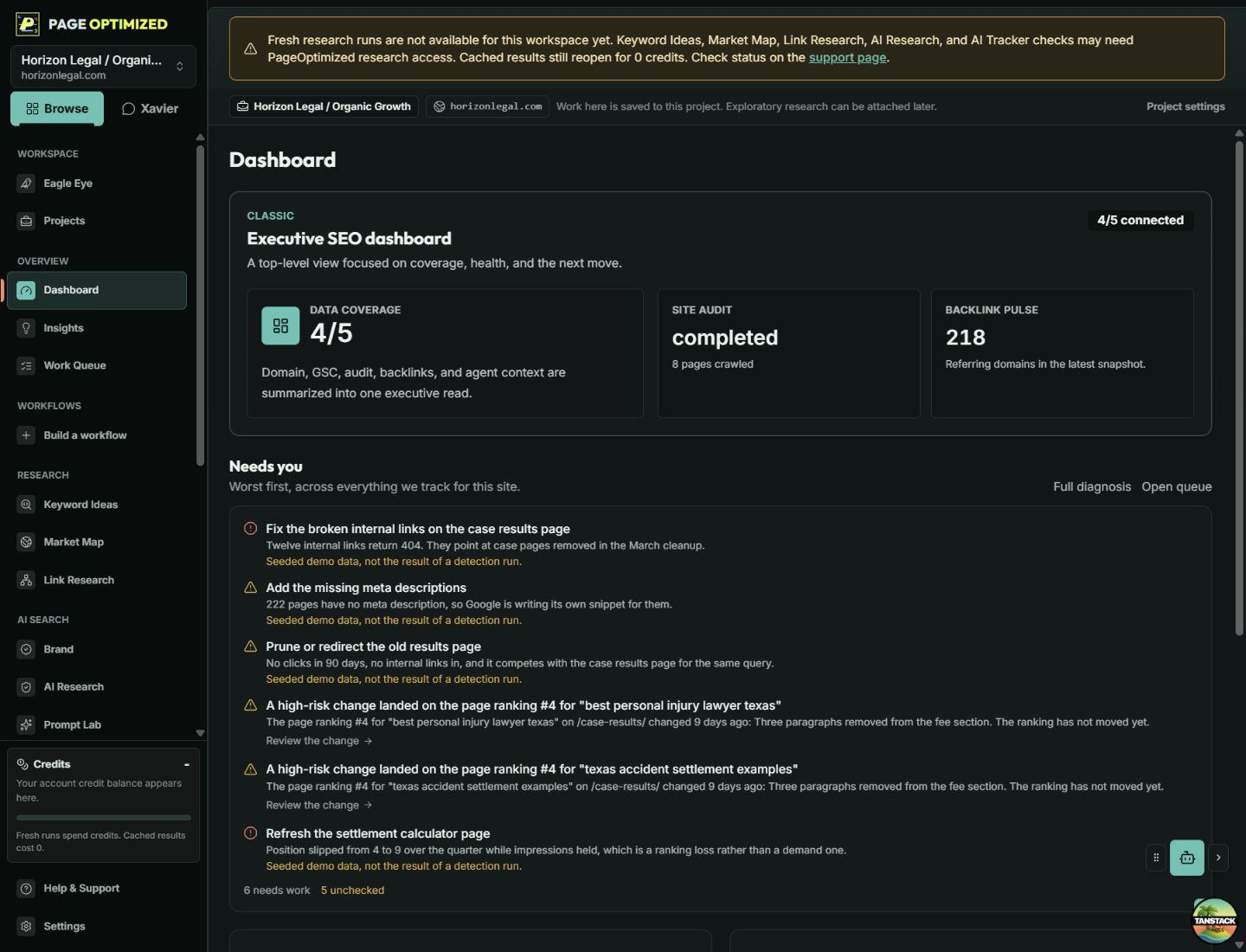
PageOptimized project dashboard showing data coverage, prioritized work, Search Console metrics, site audit issues, and backlink movement for the Horizon Legal example project.Open full size
  1. Read 4/5 connected in Data Coverage.
  2. Confirm Site Audit and Backlink Pulse are present.
  3. Notice Analytics is the missing outcome source.
  4. Create the measurement setup item shown in the completed brief.

Before you move on

  • The outcome can be observed or measured.
  • The guardrail could reveal a low-quality traffic increase.
  • The statement makes sense without SEO terminology.
Lesson 1.2

Separate crawling, indexing, ranking, and answers

Diagnose the stage that failed instead of treating every visibility problem as a ranking problem.

Why this matters

A crawler discovering a URL does not mean the URL was indexed. An indexed URL is not guaranteed to rank. A ranking page is not guaranteed to earn a click, conversion, mention, or citation. Each stage has different evidence and different fixes.

AI answer surfaces add another retrieval and response layer, but they do not erase the need for accessible pages, clear information, and trustworthy sources.

Build yours

  1. Discovery: verify that internal links or a sitemap expose the URL.
  2. Access and rendering: verify status, robots controls, resources, and rendered content.
  3. Indexing: inspect the canonical and indexing state in Search Console.
  4. Ranking and presentation: review query, page, country, device, title, and snippet evidence.
  5. Answer visibility: record the exact prompt, engine, mode, date, response, source, and whether the claim is accurate.
Completed example: Horizon Legal

Diagnosis record for the settlement calculator

The same URL is checked at every stage so the team fixes the stage that failed.

Stage checks

Discovery
PassThe URL is internally linked and present in the project.
Access and rendering
Not yet verified for this URLThe audit has one unreadable page; open the Pages tab to confirm whether it is this URL.
Indexing
Observed during the period; current state unknownSearch Console activity proves the page appeared, not that its current canonical and index state are unchanged.
Ranking
Failed signalTracked position moved from 4 to 9.
Demand
No matching lossImpressions held during the movement.
Answer visibility
UnknownNo fixed prompt test exists for this page.
Decision

The evidence confirms ranking loss while demand held, but not its cause. First match the unreadable audit URL and verify current indexing; then inspect page changes, competing URLs, and the result page.

Save this in

Work Queue: Diagnose settlement calculator ranking loss. Attach the Rank Tracker history and Search Console query segment.

Before you move on

  • Every diagnosis names a stage.
  • A failed stage has a matching verification method.
  • No answer-engine observation is presented as a guaranteed ranking cause.
Lesson 1.3

Build a measurement tree

Connect leading indicators to outcomes without claiming causation the data cannot prove.

Why this matters

Use three layers: work completed, visibility observed, and audience or business outcome. Keeping these separate makes reports honest and makes stalled projects easier to diagnose.

Build yours

  1. List completed work: fixes shipped, pages improved, briefs approved, or links earned.
  2. List visibility signals: valid indexed pages, impressions, ranking cohorts, clicks, AI mentions, citations, or source coverage.
  3. List outcomes: qualified actions, revenue, readers, appointments, or approved client goals.
  4. Add the date range, segment, and comparison period to every metric.
  5. Label relationships as observed, plausible, or verified.
Completed example: Horizon Legal

Q3 organic measurement tree

The tree separates work, visibility, and business outcomes so a completed task is never reported as a result by itself.

1. Work completed

Baseline artifact
Organic baseline captured Aug 21, 2026
Technical evidence
Site Health run completed; 8 pages attempted
Search evidence
Calculator cohort and rank history saved
Optimization changes
None shipped yet; this is the takeover baseline

2. Visibility observed

Technical state
70% health; 7 of 8 pages readable
Organic reach
366,713 impressions; 11,198 clicks; 3.1% CTR
Calculator cohort
132 clicks; 6,200 impressions; 2.1% CTR; avg. position 13.1
Tracked change
Position 4 to 9 while impressions held

3. Audience and business outcome

Qualified consultations
Unknown until Analytics is connected
Signed cases
Unknown until CRM outcomes are joined
Relationship status
Visibility is observed; business impact is not yet verified
Decision

Use the tree for the next report, but keep the outcome branch explicitly incomplete until the missing systems are connected.

Save this in

Project record: Organic measurement tree - Q3 2026. Link each row to its source view and comparison period.

Before you move on

  • Work is not reported as an outcome.
  • Visibility is segmented by a useful dimension.
  • Causal language is reserved for tested or strongly verified cases.
Lesson 1.4

Capture the baseline in PageOptimized

Save a reproducible starting point before deciding what to change.

Why this matters

A baseline is not a screenshot of one big number. It is a dated view of coverage, health, search movement, tracked topics, and known limitations that can be reopened after work ships.

Build yours

  1. Confirm the project domain, market, and reporting period.
  2. Review data coverage on the Dashboard and note missing connections.
  3. Open Search Console and record clicks, impressions, CTR, average position, and the most important page or query segments.
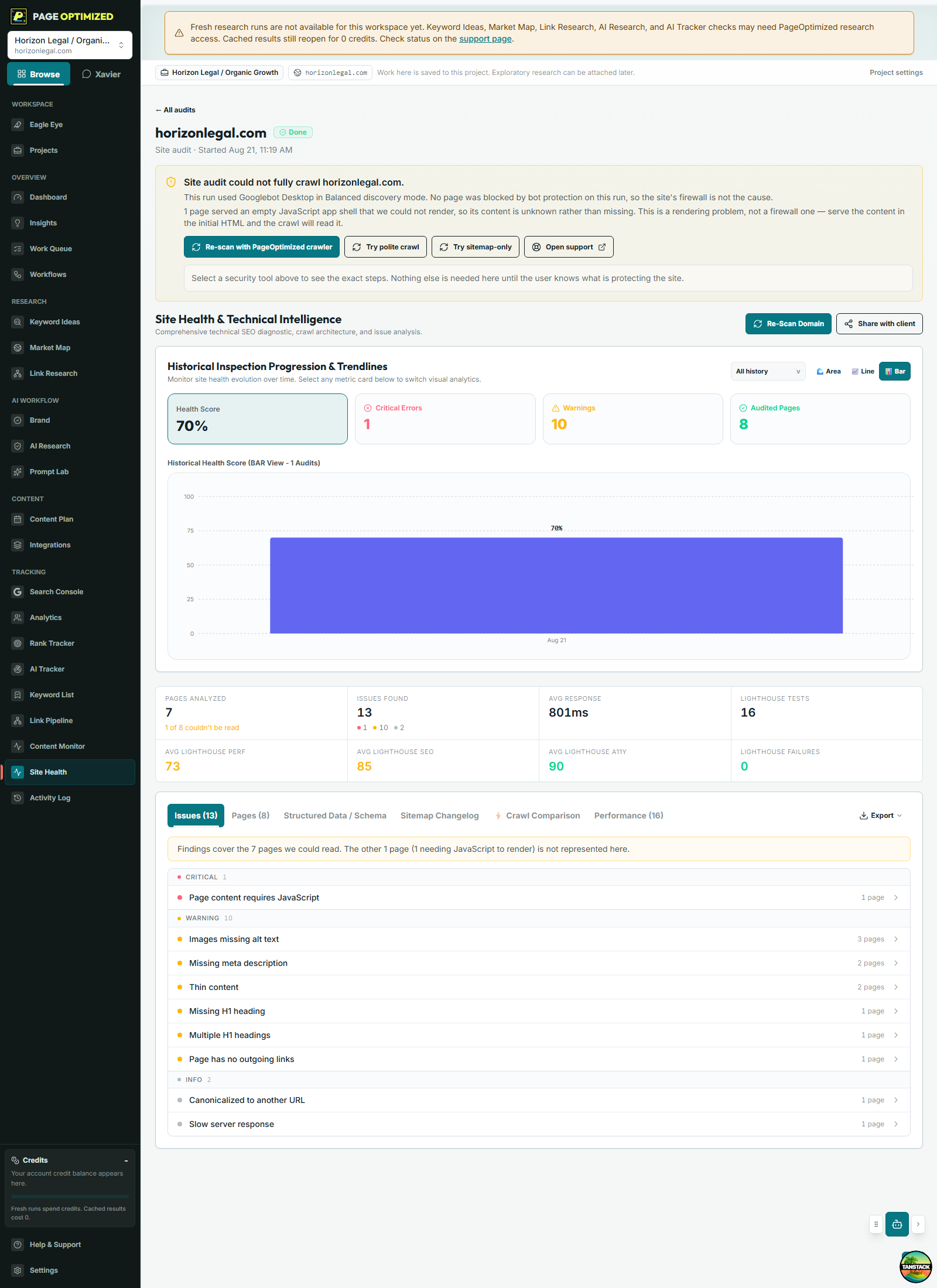
  4. Open Site Health and record crawl scope, critical issues, warnings, and pages audited.
  5. Save the three highest-priority gaps or unknowns as owned follow-up work rather than pretending the baseline is complete.
Completed example: Horizon Legal

Organic baseline captured Aug 21, 2026

This is the reproducible record created from the four PageOptimized views shown below.

Scope and search movement

Period
Jul 22-Aug 18 vs. previous 28 days
Market and device
United States; all devices
Search Console
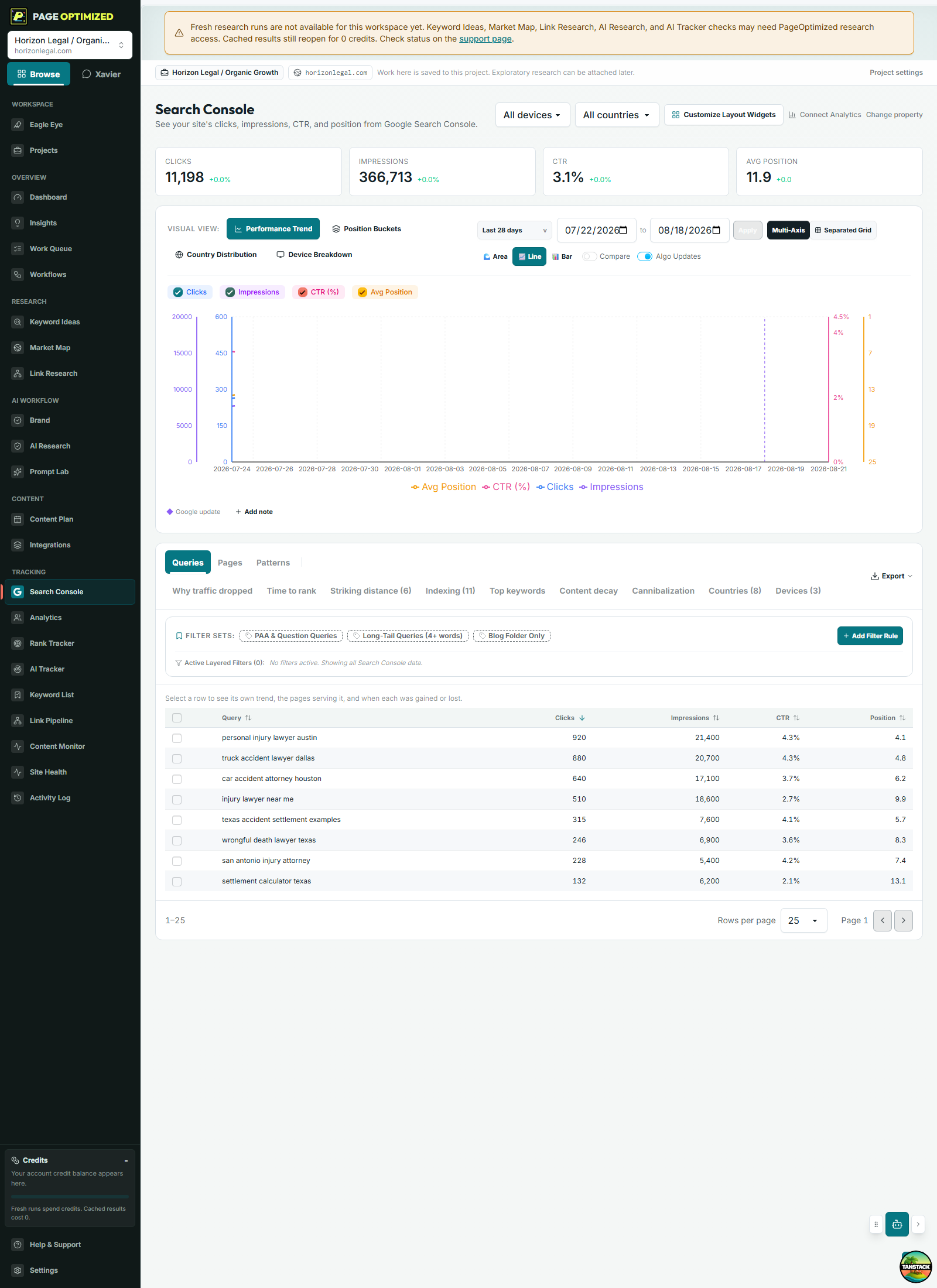
11,198 clicks; 366,713 impressions; 3.1% CTR; 11.9 avg. position
Tracked set
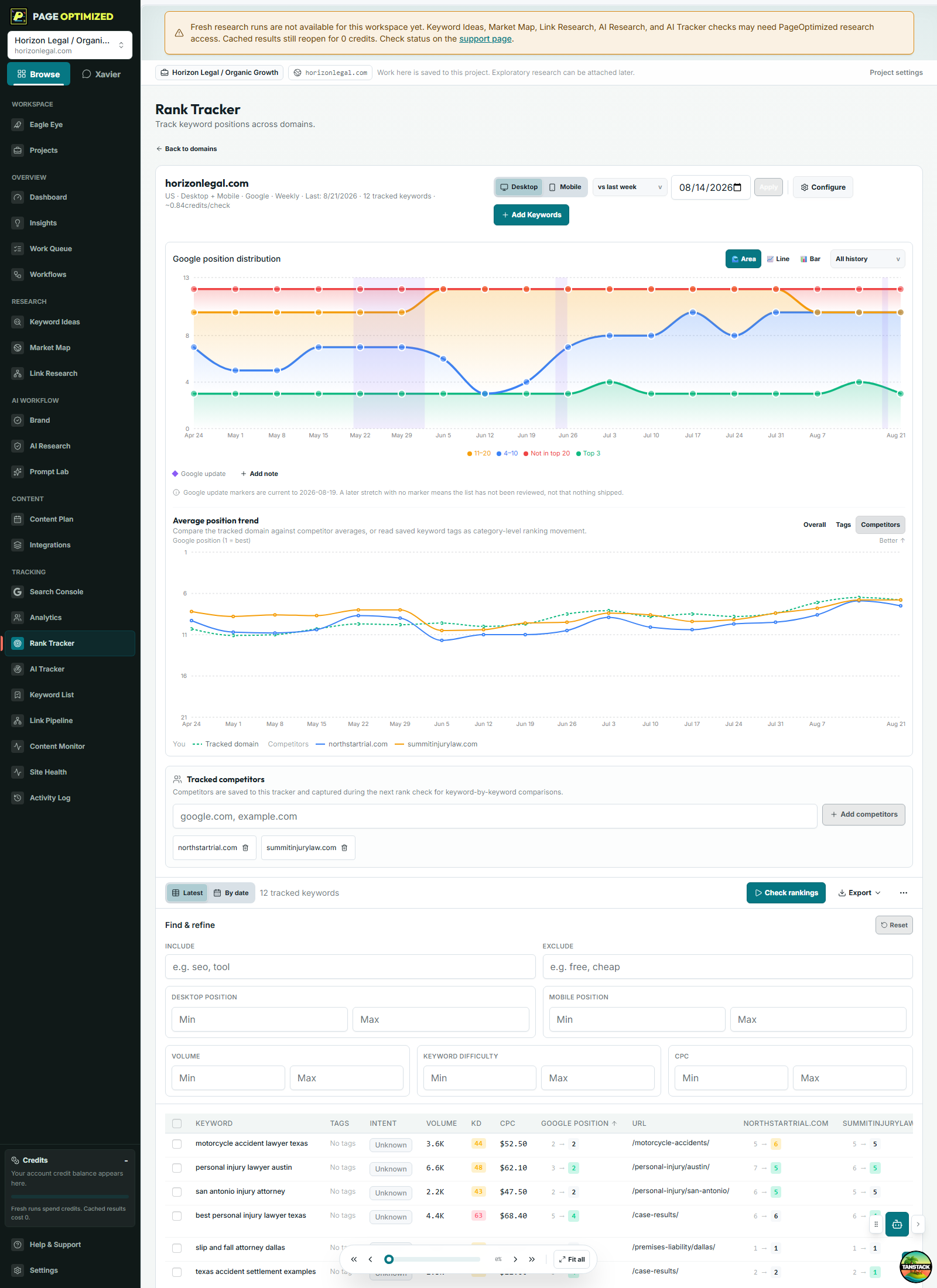
12 keywords; Google; desktop and mobile; weekly

Coverage, health, and limits

Connected evidence
4 of 5 sources
Site Health
70%; 1 critical; 10 warnings; 8 pages sampled, 7 readable
Missing outcome data
Analytics and CRM conversion connection
Next comparison
Reopen Aug 28 after fixes and measurement setup

Owned follow-up work

Measurement
Connect Analytics and consultation eventsOwner: Analytics lead. Due Aug 28.
Rendering
Identify and repair the unreadable audited pageOwner: Engineering. Due Sep 2.
Internal paths
Repair 12 links returning 404Owner: Web team. Due Sep 2.
Decision

Start with the unreadable page, 12 broken links, and measurement connection. Do not present the baseline as complete conversion reporting.

Save this in

Work Queue item: Organic baseline - Aug 21, 2026. Keep metrics in their source histories; save scope, links, limitations, owners, and review date in the item.

Product source · Search Console

Establish the organic baseline

Use the visible date and filter controls to reproduce the period, then record 11,198 clicks, 366,713 impressions, 3.1% CTR, and 11.9 average position. The query rows preserve the segment behind the totals.

PageOptimized Search Console queries view with clicks, impressions, click-through rate, position, filters, and query rows.Open full size
  1. Set Jul 22-Aug 18 and the previous-period comparison.
  2. Confirm United States and all devices.
  3. Record the four totals and the settlement-calculator cohort.
  4. Link this view from the dated baseline item.
Product source · Site Health

Record the crawl scope and technical state

The Site Health run supplies the technical branch of the baseline: 70% health, one critical issue, ten warnings, eight pages attempted, and seven readable. Those limits travel with every conclusion from this run.

PageOptimized Site Health audit for Horizon Legal showing crawl scope, health score, issue counts, performance metrics, and audit tabs.Open full size
  1. Record the Aug 21 run date and eight-page scope.
  2. Record seven readable pages and one unreadable page.
  3. Keep the critical and warning counts separate.
  4. Link the run to the baseline and remediation queue.
Product source · Rank Tracker

Record the rank-tracking scope

Rank Tracker defines the monitored cohort: horizonlegal.com, Google, desktop and mobile, weekly, with 12 tracked keywords and two saved competitors. It is a deliberate sample, not all organic demand.

PageOptimized Rank Tracker for Horizon Legal showing the tracked domain, engine, devices, cadence, keyword distribution, competitor history, and keyword table.Open full size
  1. Record the domain, engine, devices, and weekly cadence.
  2. Record the 12-keyword sample size.
  3. Keep competitor history attached to the tracker.
  4. Use Search Console for demand outside this monitored set.

Before you move on

  • The baseline has a date and comparison period.
  • Missing data is explicit.
  • A future reviewer can reproduce the same view.
Primary references

Verify the practice at the source.

Practices and source links reviewed August 2026.